The truth behind the risk and how you can truly protect your ideas.
Why Protecting Your App Idea Matters and How to Actually Do It Before It Gets Stolen
Picture this: You have an incredible idea for a new app that you’re sure users will love. You’ve spent countless hours dreaming of the concept, but you have no clue where to go from there. You need help building it, but sharing your concept feels like handing over something you may never get back. You just can’t seem to bridge the gap between the idea and execution. If you can relate to this scenario, you’re not alone. Countless people just like you have amazing ideas, but never bring them to life, either out of fear or lack of knowledge.
But there’s good news; while the risk of having your app idea stolen is real, it’s also manageable through platforms like LastApp.ai that let you bring your concept to life without turning to outside developers. When it comes to building apps, knowledge truly is power. Many founders don’t get their ideas off the ground because they don’t know what can actually be protected. This article is the answer. We’ll teach you how to successfully (and legally) keep your app idea from being stolen so you can have confidence bringing your concept to life.
Key Insights
- Genuine pre-launch theft is very rare; the biggest risk is oversharing the app's technical details with a developer before an agreement is signed.
- The reality is that you can’t copyright an idea, only the code, designs, and content that brings it to life. Most founders waste time trying to protect the wrong thing.
- Large % of the top Google Play apps and App Store apps have been copied at some point. The real risk is post-launch copying, not pre-launch theft.
- Most founders don’t know they can get a provisional patent through the USPTO for only $320 that provides 12 months of “patent-pending” protection.
- If you use a freelancer to develop your app without a work-for-hire clause, they legally own the code they write under US copyright laws. Verbal agreements aren’t enough to protect you.
- The cheapest and fastest way to protect an idea is to build the app yourself. Without a developer, you don’t have to worry about exposure, NDA enforcement, or automatic copyrights.
What Can You Actually Protect? The Idea vs. The Execution Distinction
When designing an app, it’s important to understand what you can and can’t protect. The fact is, you can’t trademark, patent, or copyright an idea; you can only protect its execution. This protection covers areas like the brand, written content, the UI, and the code. Too many founders don’t realize this fact and waste too much energy protecting the wrong things. The secret is knowing how to validate your idea before committing to development. Here is a quick guide on how to safeguard your concept throughout the entire process.
| Stage | Protection Tools |
|---|---|
| Stage 1: Idea Only (nothing built yet) | Limit who you tell. Use an NDA before any app related conversations. Use timestamps to document your idea (email yourself, use Google Docs version history, etc.) |
| Stage 2: Building (prototyping or in-development) | Use work-for-hire and IP assignment clauses with all contractors. Implement a strict need-to-know access control and NDAs with advisors and investors. Use private code repositories (GitHub/GitLab) |
| Stage 3: Live app (launched) | Copyright both UI and the code, register at copyright.gov ($65) for the right to sue. Trademark your logo and name (USPTO, Class 42 $250 - $350) Monitor Google Alerts for clones and learn the App Store DMCA takedown process. |
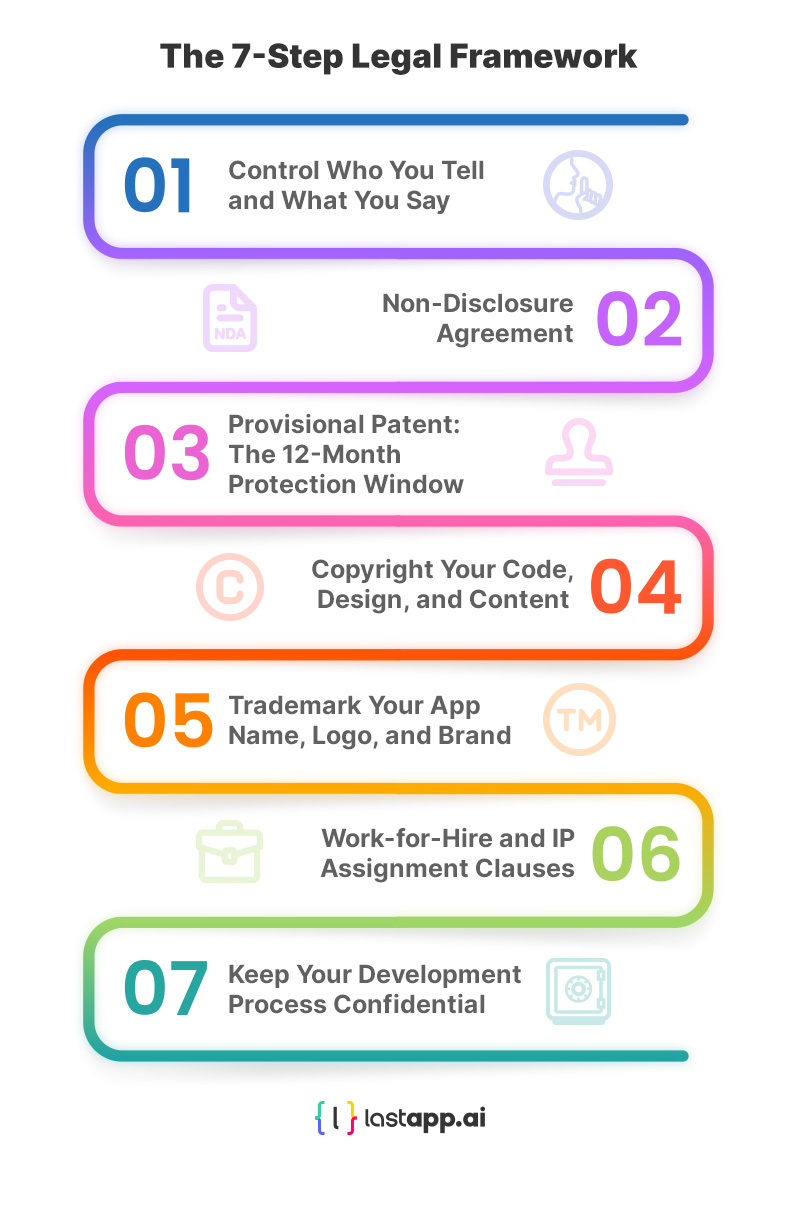
How to Protect Your App Idea: The 7-Step Legal Framework
By far, the cheapest and fastest protection is to build the app yourself. No developer means there’s no exposure, you don’t have to enforce an NDA, and you get automatic copyright. But don’t worry, we’ve laid out a 7-step legal process to follow that will help ensure your ideas stay safe.
Step 1: Control Who You Tell and What You Say
Limiting who you talk to about your app idea keeps it private and protects it before you can set up legal agreements. Building a working MVP as your first protection step will give you peace of mind and help make sure your idea stays private. Remember, you can share the problem you're solving, but never the technical solution, UX flows, monetization model, or the unique features.
Protects: Your unique execution details
Doesn’t Protect: Your general concept from someone developing the same idea.
Step 2: Non-Disclosure Agreement
An NDA is a legal contract that forces the other party to keep your idea private. You should always use one with co-founders, advisors, investors, and developers. They’re free if you use a template from DocuSign or LawDepot.
Protects: Confidential information used and shared during development, investor conversations, and in advisory relationships.
Doesn’t Protect: Someone building a similar app from an idea they developed independently.
Step 3: Provisional Patent: The 12-Month Protection Window
To protect your idea, you can get “patent pending” status for only $320 at USPTO.gov that lasts for 12 months. For a full utility patent, expect to pay between $10,000 and $30,000 + attorney fees, and the process can take around 2 years or more.
Step 4: Copyright Your Code, Design, and Content
When you create the app yourself, you get the copyright automatically. If you want extra protection, you can also register at copyright.gov for $65. With this, you can sue for statutory damages if someone steals your source code, original visual assets, icons, app copy, or the design system.
Protects: Source code, original visual assets, icons, app copy, or the design system
Doesn’t Protect: Your app idea
Step 5: Trademark Your App Name, Logo, and Brand
You can file a trademark through USPTO under Class 42 (SaaS/ Technology) for $250 to $350 per class. It takes about 8 to 12 months for approval. Just be sure to run a trademark scan before you commit to a name.
Protects: Your app’s name, logo, and brand from competitors in your category.
Doesn’t Protect: The concept, logic, or function of your app.
Step 6: Work-for-Hire and IP Assignment Clauses
If you don’t use a work-for-hire agreement with a freelancer who writes your code, they legally own it under US copyright law. You should always use this agreement and include: (1) clear work-for-hire language, (2) an IP assignment clause, and (3) a project duration and non-compete clause. Remember, verbal agreements won’t hold up in court.
Protects: Code ownership so everything the contractor builds belongs to you.
Doesn’t Protect: A contractor independently building a competing app after the project ends.
Step 7: Keep Your Development Process Confidential
Even though you may be excited to share your development process, the best way to protect it is to keep it private. Use platforms like GitLab or GitHub, limit access, jumble the code in the published build, set Google Alerts for your app’s name, and keep a timestamped development log.
Protects: Unique app features and technical architecture during the development process.
Doesn’t Protect: The visible features and UI from reverse engineering once your app is published.
Can a Developer Actually Steal Your App Idea? The Honest Answer
Here’s the truth: You can’t copyright, patent, or trademark an app idea, only its execution. That protection only covers the brand, written content, UI, and the code. As we talked about before, too many founders are wasting their time, energy, and money on protecting the wrong things. But what about the actual app idea? Can you protect it? Well technically, yes, but practically unlikely. There’s no legal protection for a concept, the way you keep your app idea safe is by following the steps we mentioned above. Ultimately, to keep a developer from stealing your app idea, you simply shouldn’t share the details without having a legal agreement signed. What are the most common real risk scenarios you should look out for?
The 3 Real Risk Scenarios
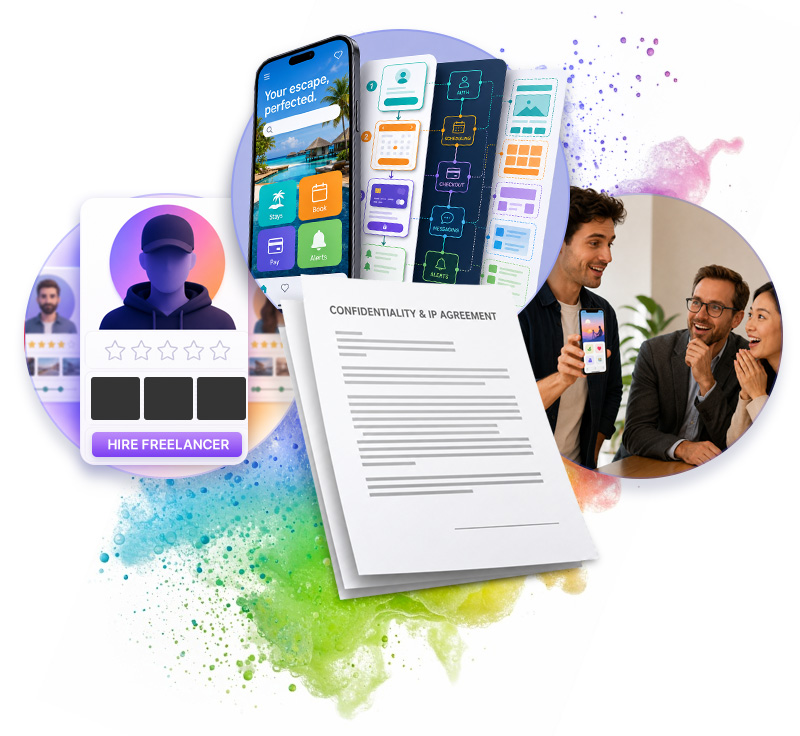
Risk 1: Offshore or unvetted freelancers with no reputation to protect
Unvetted freelancers that come from a job board and have no profile history pose a serious risk, unlike established agencies with Clutch profiles and references whose businesses depend on repeat clients and referrals.
Risk 2: Oversharing technical details before any agreement is signed
Volunteering your unique UX logic, monetization model, and technical architecture without having legal protection is a much bigger threat than a developer stealing your concept.
Risk 3: Advisors and investors without proper agreements
At the end of the day, the developers aren’t the biggest risks; it’s the advisors and investors who get hundreds of pitches without having a contractual obligation that are more likely to steal your ideas.
How to Protect Your App Idea Without a Developer? What to Share and What to Never Reveal?
Each step when taking a traditional path to app development either takes time (patents can take years), money (expect to pay $300 to $30,000+ by the time you’re done), or trust (NDAs are only as strong as your ability to enforce them). But there’s one approach that doesn’t require any of those.
Building the app yourself means you don’t have to share your ideas with a developer, enforce NDAs, or risk exposure. It’s truly the best way to ensure your app idea stays safe.
| Safe to Share (Without NDA) | Never Share Without a Signed NDA |
|---|---|
| The problem your app solves | The technical architecture and structure. Proprietary API configurations, integrations, or data sources |
| Your target user | Specific algorithm or unique features. |
| The general category (fitness, booking, productivity, etc.) | Unique UX interactions or flow patterns |
| That the project exists and is being developed | Monetization model, revenue projections, and pricing strategy |
| Your desired launch time | Feature roadmap beyond the core MVP |
Why This is Now Possible for Non-Technical Founders
In the past, you’d have to know how to code to develop your own app, which also meant hiring someone and accepting the risk involved. But, thankfully, that’s no longer true.
Thanks to no-code platforms like LastApp.ai, you can simply describe your app idea in plain English and get a working native iOS, Android, and web app in just one session. You can say goodbye to developers, and you don’t need any technical skills. Your idea stays yours from the first prompt to the App Store.
With your working build, you automatically have:
- Copyright from the moment of creation
- Timestamped development proving the creation date
- Zero development-threat risk
Control is in your hands, and you can enjoy complete peace of mind!
The Bottom Line: Your App Idea is Worth Protecting, Here is Where to Start Today
You can’t protect your idea, just its execution. Every legal tool we’ve laid out in this article works best when used together from the start. It begins with information control and an NDA, then you need to add the legal registrations and make sure you have a written agreement with every contractor from day one. It’s honestly exhausting, and one misstep can make you lose everything.
If you want to skip the development risk and move from idea to a working app without sharing any details, LastApp.ai is the answer. Build a native iOS, Android, and web app from a single prompt with no developer, no disclosure, and no exposure ever.