Figuring out how customers pay inside a mobile app is not as simple as you might think. There are differences between in-app purchases vs mobile site payments that can ripple through your business revenue pretty quickly.
When you get the revenue decision right, you maximize revenue at each stage. Get it wrong, and you end up spending tens of thousands of dollars on platform fees you could have avoided or failing to attract paying customers due to too much checkout friction.
Where you take revenue is a margin-versus-distribution decision. You have to balance how much money you want to keep on each sale against how easy it is for customers to find, buy, and engage with your product. That balance for your app monetization strategy is what this article is all about.
Key Insights:
- In-app purchases consistently convert better than a mobile web checkout because of the integrated Apple Pay and Google Pay systems, which reduce checkout friction.
- Apple and Google charge around 15% to 30% commission, but only on certain digital goods sold inside an app, not on physical products like restaurant orders or offline services.
- Spotify avoids in-app purchases by directing customers to its website. Netflix removed subscription app revenue by doing the same.
- Most successful subscription-based apps use a hybrid approach of in-app purchases and encouraging web-based subscriptions.
- For MVPs or first-time founders, in-app purchases are the fastest and easiest way to launch.
- Only when recurring product revenue hits $5K to $10K per month should you worry about platform fees and reevaluate the current billing model.
- Developing with platforms like LastApp.ai supports a hybrid approach to in-app billing and external payment flows, avoiding being “locked into” one model.
What Is the Real Difference Between In-App Purchases and Mobile Site Payments?
When you’re first examining how do free apps make money or what payment infrastructure your startup needs to pursue, you don’t have to be overwhelmed with technical context. It’s more a business decision around how you want customers to journey through your app or mobile site, where you want revenue directed, and what pricing flexibility you’ll need for long-term growth and scaling.
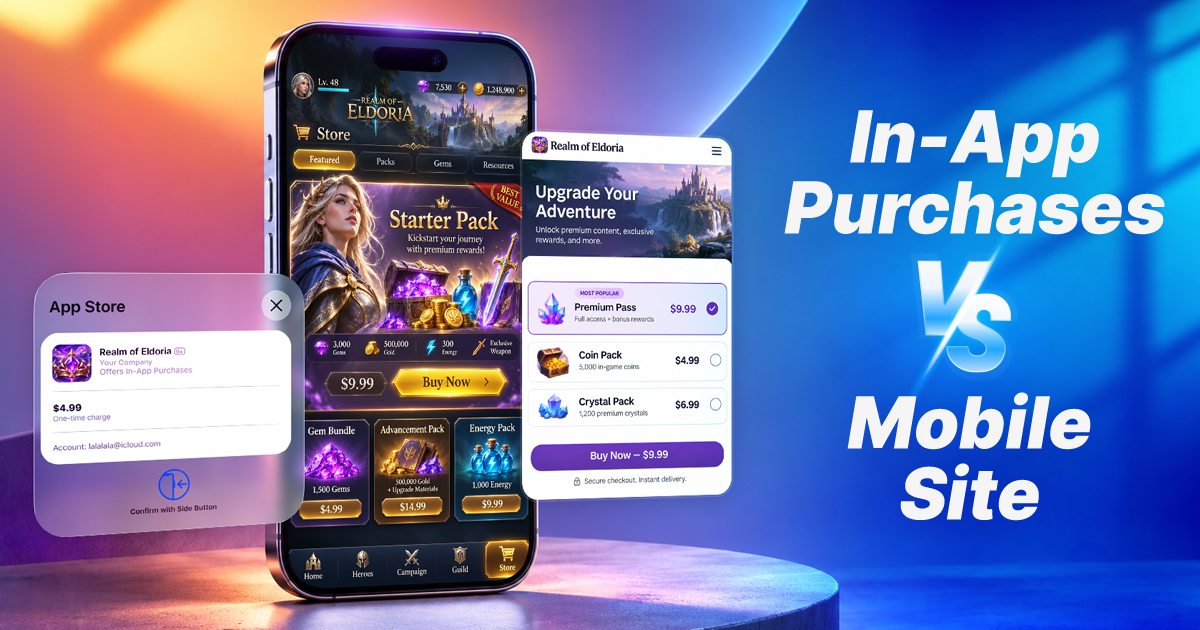
In-app purchases stick to the preexisting systems inside Apple’s App Store or Google Play’s payment infrastructure. Customers complete any purchase using the stored credit cards or other payment info on the device. That is confirmed with a code or biometrics, such as Face ID. Such options are fantastic for your app’s convenience, but also mean you’ll pay anywhere from 15% to 30% in store commissions.
A mobile site is more of the opposite approach. Most customers will purchase on your site, but through a third-party processor like PayPal or Stripe. You keep more of the sales and customer data, but there are more steps for customers to follow, which can reduce revenue.
The goal for your platform fee app store, or third-party processor is the same. You either decide to rent the checkout or own it. Either way, there are compounding costs in your business decision.
Which Converts Better: In-App Checkout or Mobile Web?
The often easier metric to compare in-app purchases vs mobile site payments is the conversion rate. Most consumer apps stick to in-app purchases because, according to AppsFlyer, these convert better than web checkout. The average conversion ranges from 9.5% for food and drink apps at the low end to over 62% for auto apps. These are native payment systems that remove the friction between the customer and the purchase.
It’s a structural gap. The average web purchase conversion rate is between 2.5% and 5.5%, and you also have to worry about cart abandonment. Apple Pay and Google Pay eliminate form fields and repeated authentication, whereas you’ll keep more money with web payment options.
You have to decide based on user intent. Someone who visits your website selling e-scooters for heavy people wants discounted rates, annual subscriptions to your emails, and other insights. They expect additional steps and are motivated past purchase friction. A casual user who encounters a paywall won’t be as motivated.
All these conversion rates will vary by app category, price point, and customer-to-product familiarity, but they give you decent benchmarks between ease of payment, web cart abandonment, and conversion goals.
Do You Always Have to Pay Apple or Google's 30% Fee?
It’s extremely important that you understand when Apple's or Google’s 30% fee applies. No matter if you’re working with no-code app development or trying to grow subscription app revenue, the platform fees matter.
Both app stores take a cut only on digital goods purchased “inside” the app. The things processed by the app do not apply. Any physical goods, offline services, ride bookings, or restaurant orders are also exempt from commissions.
For example, Uber charges in-app, but that doesn’t trigger the higher commission fee. A meditation app that sells a digital course on relaxing each muscle group while listening to guided instructions cannot avoid the fee.
| Subject to Platform Fee | Exempt from Platform Fee |
|---|---|
| Digital subscriptions | Restaurant food orders |
| Premium app features | Uber rides |
| Digital courses or eBooks bought “in-app” | Physical retail products |
If you build a mobile app that touches physical goods, like a line of cat clothing, or offline services, like mobile pet grooming, you already have pricing flexibility built into your business.
Knowing this difference helps you legally save a lot of money from platform fee app store commissions.
How Do Spotify and Netflix Avoid Paying Apple's Cut?
It may help to use some practical examples of larger-volume mobile apps that are native to both ecosystems. Many new developers are looking for an app monetization strategy that includes subscription app revenue, such as the perceived revenue for Netflix and Spotify. The trick is that both use a hybrid model.
Spotify likes to direct new subscribers to its website platform. That is where accounts are created and payments are managed, rather than through in-app purchases. With Netflix, the online streaming behemoth removed iOS in-app subscription sign-ups, pushing new users to the web before logging into the mobile app.
The reason for both apps using a hybrid approach is scale. Saving a 30% fee from the 293 million Spotify subscribers or the 325 million Netflix subscribers helps a company’s bottom line in meaningful ways.
Large companies building apps through traditional or no-code app development can scale faster with a hybrid model. Considering how the EU’s Digital Markets Act forces Apple to allow third-party payment options across Europe, hybrid billing seems more appealing anyway.
You'll need to weigh whether you’re looking long-term or need an MVP in the shorter term. Hybrid may make more sense, but sticking to in-app purchases helps avoid unnecessary complexity.
Should You Start with In-App Purchases or Web Billing?
For most first-time founders and those hoping to get to an MVP to market faster, it makes sense to stick with in-app purchases. It's faster to configure when no separate payment gateway is required, and being native to the app store provides you with built-in user trust. That means higher conversion rates, especially when every purchase counts.
At low revenue, when speed is a factor, in-app purchases make more sense.
Once your company reaches a monthly revenue level of $5K to $10K, the platform fee app store expense should trigger a new review. At the $10K MRR level, a 30% commission fee is roughly $3K per month. You have to ask yourself if the premium you’re paying makes sense for your current revenue, but until you reach that point, in-app purchases are the right starting point.
This convenience and speed-to-market are big reasons why no-code app development using platforms like LastApp.ai makes a lot of sense. It supports both in-app purchase flows and external, third-party billing links. Instead of getting locked into one or the other, you can start with the fastest option for your app, then optimize to a hybrid model once the margin is proven.
Conclusion
Choosing between in-app purchases vs mobile site payments comes down to speed, user intent, and what works best for your business. In-app purchases trade margin for speed and conversion, but mobile site billing adds friction when you get more revenue control. Most of the successful mobile apps right now use a hybrid of both.
The right choice depends on your revenue stage. You have to decide if the platform fee is worth what it buys right now.
With LastApp.ai, first-time founders can configure in-app purchases from the start, then switch when revenue and demand make more sense. That provides the scaling needed to launch quickly today, then optimize down the road.